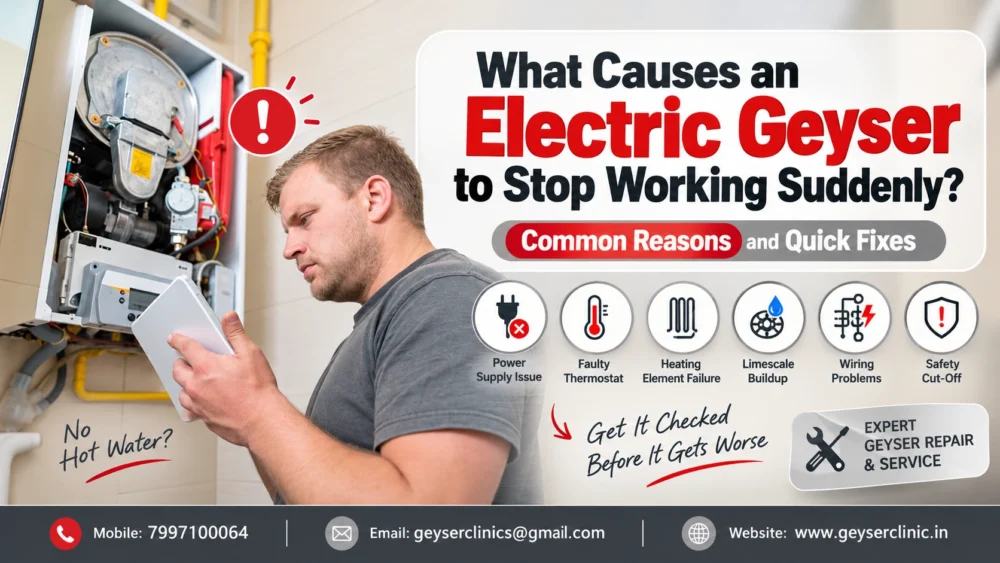
What Causes an Electric Geyser to Stop Working Suddenly?
An electric geyser can appear to work normally one day and suddenly stop heating water the next. In many cases, the failure only looks sudden. A heating element, thermostat, safety cutoff, wiring connection, or other internal component may have been gradually deteriorating before finally reaching a point where the geyser could no longer operate.
For homeowners in Hyderabad, a sudden geyser failure can be especially inconvenient when hot water is needed immediately. If you are searching for a Geyser repair center in Beeramguda, the first step is to understand whether the problem is a simple power interruption, a heating-component failure, a safety shutdown, or a water-related issue.
Quick Answer: Why Does an Electric Geyser Stop Working Suddenly?
The most common possible causes include:
- Tripped MCB or interrupted electrical supply
- Failed heating element
- Thermostat malfunction
- Thermal safety cutoff/ECO activation
- Loose, damaged or overheated electrical connection
- Heavy scale or sediment buildup
- Faulty electronic control or sensor on models that use electronic controls
- Water supply or valve-related problems
- Internal leakage or corrosion
- Age-related component failure
A technician needs to test the actual system before identifying one of these as the confirmed cause.
1. The Geyser May Have Lost Its Electrical Supply
The simplest possibility is that the geyser is no longer receiving power.
A circuit breaker may have tripped because of an electrical fault, overload or abnormal condition. Some installations may also have a dedicated switch or isolator controlling the geyser.
If the power indicator is off, check only the accessible external switch or electrical control that you normally use. Do not remove covers or touch internal wiring.
If the breaker repeatedly trips after being restored, don’t keep resetting it. Repeated tripping can indicate an underlying electrical or appliance fault that requires professional diagnosis.
2. A Heating Element May Have Failed
The heating element is the component responsible for converting electrical energy into heat.
When an element burns out or develops an electrical fault, the geyser may suddenly stop producing hot water even though the tank itself appears normal.
Typical symptoms can include:
- Water remains completely cold.
- The geyser previously took longer to heat before failing.
- The indicator may behave differently depending on the model.
- A fault code may appear on electronic models.
- One heating stage may stop functioning in models with multiple elements.
A visual inspection from outside cannot confirm whether an element has failed. Proper electrical testing should be performed by a qualified technician.
3. The Thermostat May Have Stopped Controlling Temperature
The thermostat monitors water temperature and controls when the heating element operates.
If the thermostat becomes faulty, the geyser may:
- Stop heating.
- Heat inconsistently.
- Produce water that is not hot enough.
- Stop heating after reaching an incorrect temperature.
- Trigger a safety cutoff.
Because thermostat faults can overlap with heating-element and safety-device problems, replacing a part without diagnosis can result in an unnecessary repair.
4. The Safety Cutoff May Have Activated
Electric geysers commonly incorporate temperature-limiting or over-temperature protection.
If the system detects an abnormal temperature condition, the safety mechanism can interrupt heating.
This is important: a safety cutoff should not simply be bypassed.
A technician should determine why the safety device operated. Possible underlying causes can include thermostat problems, heating-element issues, control faults or abnormal operating conditions.
Do not attempt to bypass, bridge or permanently disable a geyser’s safety device.
5. Scale and Sediment Can Contribute to Failure
Minerals in water can gradually accumulate inside a storage geyser.
Heavy deposits can interfere with heat transfer and make the heating system work harder. Over time, sediment and mineral buildup can contribute to poor heating performance and increased component stress.
You may notice warning signs before complete failure, such as:
- Increasingly slow heating
- Lukewarm water
- Unusual popping or rumbling sounds
- Higher-than-usual heating time
- Reduced hot-water availability
However, scale buildup is not automatically proof that the heating element has failed. Internal inspection and appropriate servicing are needed to establish the actual condition.
6. Electrical Connections or Internal Components May Have Failed
An electric geyser depends on several electrical connections and control components.
A problem with internal wiring, terminals, sensors, relays or electronic controls can interrupt heating.
This becomes particularly relevant when:
- The geyser suddenly stops after previously working normally.
- The external power supply appears normal.
- The unit has an electronic display or diagnostic indicator.
- A fault code or unusual indicator pattern appears.
- The breaker trips when the heater operates.
Do not open the electrical compartment to inspect live or internal wiring yourself. Electrical diagnosis should be carried out by a qualified service professional.
7. Water Supply Problems Can Sometimes Look Like a Geyser Failure
Not every hot-water complaint originates from the heating system.
A closed or partially closed water valve, plumbing problem, restricted flow or incorrect hot/cold water connection can affect the amount or temperature of water reaching the outlet.
Before assuming that the geyser itself has failed, check whether:
- Cold water is available normally.
- Hot water is absent at all outlets or only one outlet.
- The problem affects the entire house or one bathroom.
- Any recently completed plumbing work preceded the problem.
If only one tap or shower has the problem, the issue may be related to that fixture or its plumbing rather than the geyser.
8. Internal Leakage or Corrosion Can Cause a Sudden Shutdown
A geyser can develop corrosion internally over time. Protective components such as the anode rod help protect the tank in applicable storage-water-heater designs, but these components gradually wear.
External warning signs can include:
- Water pooling beneath the geyser
- Persistent dripping
- Rust-colored water
- Corrosion around connections
- Dampness around the tank
- A sudden drop in normal performance
If the actual storage tank has developed a significant leak, replacing an individual component may not solve the underlying problem. The condition of the tank needs to be assessed before deciding between repair and replacement.
What Should You Check When Your Geyser Suddenly Stops Working?
You can safely perform a few external checks without opening the appliance.
Safe homeowner checklist
- Check whether electricity is available in the home.
- Check the geyser’s normal external switch or isolator.
- Look at the electrical panel for an obvious tripped breaker.
- Check whether the geyser’s indicator or display is showing anything unusual.
- Check whether water is available normally.
- Check whether there is visible leakage around the unit.
- Check whether the problem affects every hot-water outlet.
- Note any unusual sounds, burning smell, repeated breaker trips or error codes.
Stop using the geyser and arrange professional inspection if you notice burning smells, exposed wiring, repeated electrical trips, significant leakage, scorching, unusual noises accompanied by leakage, or other unsafe conditions.
Does an Electric Geyser Need a Separate MCB and Isolator?
This depends on the geyser’s electrical load, installation design and applicable electrical requirements.
A geyser should have an appropriately designed electrical supply and protective arrangement. The exact MCB rating, cable size, switching arrangement and isolator requirements should be determined according to the appliance specifications and local electrical installation practices.
The important point for homeowners is simple: do not install or modify geyser electrical protection based only on a generic online recommendation.
If your geyser repeatedly trips the MCB, the objective should be finding the reason for the trip—not simply fitting a larger breaker.
Why Is My Geyser Safety Valve Leaking Water?
A temperature-and-pressure relief valve is a safety component designed to release water when pressure or temperature reaches an unsafe condition.
Occasional discharge can therefore require investigation rather than simply being treated as an ordinary plumbing leak.
Possible reasons can include:
- Excessive pressure
- Thermal expansion
- A valve that is no longer sealing correctly
- An installation or plumbing issue
- Another condition affecting the water-heating system
Never block, cap or permanently disable a pressure-relief discharge line.
If the safety valve is continuously leaking, leaking heavily, or accompanied by excessive temperature or pressure symptoms, have the system inspected by a qualified technician.
How Can I Clean or Remove Rust From a Geyser?
Rust on an external connection is different from corrosion inside the tank.
You may be able to clean minor surface dirt from accessible external areas, but internal tank corrosion should not be treated as a simple rust-cleaning job.
A technician may need to inspect:
- Tank condition
- Anode rod, where applicable
- Heating element
- Gaskets and connections
- Inlet and outlet plumbing
- Sediment accumulation
- Visible corrosion around fittings
If the tank itself is badly corroded and leaking, cleaning the outside will not restore the tank’s structural integrity.
How Does a Technician Diagnose a Suddenly Dead Geyser?
A professional diagnosis generally follows the fault rather than immediately replacing parts.
The technician may assess:
Step 1 — Confirm the symptom
Is there no hot water, lukewarm water, no power indication, or a complete shutdown?
Step 2 — Check the external supply
The electrical supply and accessible controls are assessed.
Step 3 — Identify safety shutdowns
The technician checks whether a thermal or electronic protection system has interrupted operation.
Step 4 — Test heating components
Heating elements and associated components are evaluated using appropriate electrical testing procedures.
Step 5 — Evaluate thermostat/control operation
Temperature-control components and relevant sensors are assessed according to the geyser design.
Step 6 — Inspect water-side problems
Leakage, valves, scale, corrosion and plumbing conditions are considered.
Step 7 — Determine repair versus replacement
The final recommendation depends on the failed component, tank condition, appliance age, repair feasibility and overall condition.
This approach is safer and more reliable than assuming that every sudden failure means the heating element needs replacement.
When Should You Call a Geyser Technician Immediately?
Arrange professional inspection if:
- The geyser repeatedly trips the MCB.
- You smell burning or overheated plastic.
- Water is leaking from the tank or electrical area.
- The unit has visible corrosion with leakage.
- The safety valve is continuously discharging.
- The geyser has stopped heating despite normal external power.
- An electronic model displays a fault code.
- You suspect an internal electrical fault.
- The geyser becomes unusually hot or behaves unpredictably.
Avoid opening the geyser’s electrical compartment or attempting to repair internal wiring, heating elements, thermostats or safety devices yourself.
How Can You Prevent Sudden Geyser Failure?
Sudden failures cannot always be prevented, but regular attention can identify developing problems earlier.
Useful maintenance practices include:
- Have the geyser inspected periodically.
- Address unusual noises or slow heating rather than ignoring them.
- Check for visible leakage and corrosion.
- Keep electrical protection and installation in proper condition.
- Have sediment/scale addressed when applicable.
- Inspect protective components such as the anode rod where the geyser design includes one.
- Follow the manufacturer’s maintenance recommendations.
- Avoid ignoring repeated MCB trips or safety-valve discharge.
The right maintenance frequency depends on the geyser design, water quality, usage and manufacturer recommendations.
Geyser Repair Center in Beeramguda — Service for Nearby Areas
If your electric geyser has stopped working suddenly, GEYSER CLINIC can help diagnose the actual problem instead of assuming the cause from the symptom alone.
Service support can be relevant for customers searching for geyser repair assistance around:
- Beeramguda
- BHEL
- Ramachandrapuram
- Patancheru
- Chandanagar
The useful first step is to describe what happened: whether the geyser stopped completely, stopped heating, started tripping the MCB, developed a leak, showed an error indication or began producing only lukewarm water.
Need Help With a Suddenly Failed Geyser?
Instead of repeatedly switching the unit on and off, note the symptoms and arrange a proper inspection.
GEYSER CLINIC
Mobile: 79971 00064
Email: geyserclinics@gmail.com
Related Geyser Topics
For readers troubleshooting related problems, these topics can naturally support this guide:
- Does an Electric Geyser Need a Separate MCB and Isolator?
- Why Is My Geyser Safety Valve Leaking Water?
- How Can I Clean or Remove Rust From a Geyser?
These articles can be internally linked from the relevant sections above to create a useful geyser troubleshooting content cluster.
Frequently Asked Questions
Why did my electric geyser suddenly stop working?
Possible causes include an interrupted power supply, tripped breaker, failed heating element, thermostat problem, safety cutoff, electrical fault, scale buildup or another internal component failure. The exact cause requires diagnosis.
Why is my geyser not heating even though the power light is on?
The power light generally indicates that electrical power or a control circuit is active; it does not by itself prove that the heating element is functioning correctly. A failed element, thermostat, safety device or control component can still prevent heating.
Can a tripped MCB cause a geyser to stop working?
Yes. If the geyser’s electrical supply is interrupted by a tripped breaker, heating will stop. If the breaker trips repeatedly, the underlying cause should be investigated rather than repeatedly resetting it.
Can hard water make a geyser stop working?
Hard-water minerals can contribute to scale and sediment accumulation. Heavy buildup can reduce heating performance and increase stress on heating components, but it does not prove that the geyser has failed.
Should I replace the heating element immediately?
Not necessarily. A technician should first determine whether the element is actually faulty. Similar symptoms can result from thermostat, safety cutoff, wiring, control or water-side problems.
Is it safe to repair a geyser myself?
External checks such as observing the switch, breaker status, water availability and visible leakage may be reasonable. Internal electrical components, heating elements, thermostats and safety devices should be handled by a qualified professional.
Can a leaking safety valve cause a geyser to stop working?
A leaking safety valve does not automatically mean the heating system itself has failed. However, continuous discharge can indicate a pressure, temperature, valve or installation issue that should be investigated.
When does a sudden geyser failure mean replacement is necessary?
Replacement becomes a consideration when the storage tank is severely corroded or leaking, when multiple major components have deteriorated, or when repair is no longer practical for the appliance’s overall condition. A technician should assess the unit before making that decision.
Conclusion
An electric geyser rarely stops working for just one universal reason. A sudden failure can result from a power interruption, heating-element failure, thermostat problem, safety cutoff, electrical fault, scale buildup, water-side issue, corrosion or another internal component failure.
The safest approach is to begin with simple external observations, identify the exact symptoms and avoid opening or modifying the electrical or safety components. Professional diagnosis can then determine whether the problem is repairable or whether replacement should be considered.
For homeowners in Beeramguda, BHEL, Ramachandrapuram, Patancheru and Chandanagar, GEYSER CLINIC provides a local option for diagnosing geyser heating, electrical, leakage and performance problems.
SEO Information
SEO Title: What Causes an Electric Geyser to Stop Working Suddenly?
Meta Description: Electric geyser stopped suddenly? Learn common causes, safe checks, MCB issues, heating faults and repair guidance in Beeramguda.
URL Slug: electric-geyser-stopped-working-suddenly-beeramguda
Primary Keyword: Geyser repair center in Beeramguda
Secondary Keywords:
electric geyser repair in Beeramguda, geyser stopped working suddenly, electric geyser not working, geyser not heating, geyser heating problem, geyser repair BHEL, geyser repair Ramachandrapuram, geyser repair Patancheru, geyser repair Chandanagar, geyser technician near me, geyser electrical problem, geyser heating element problem, geyser thermostat problem
Semantic Terms:
electric water heater, storage geyser, heating element, thermostat, thermal cutoff, ECO, MCB, isolator, electrical supply, sediment, scale buildup, hard water, anode rod, corrosion, safety valve, pressure relief valve, temperature control, electronic control, sensor, leakage, tank corrosion, plumbing, hot-water recovery, geyser maintenance
Search Intent: Problem-solving informational + local service intent
Featured Image Concept:
A premium 16:9 image showing a modern electric storage geyser in a Hyderabad home utility/bathroom setting, with a professional technician diagnosing the unit safely. Include subtle visual cues for a tripped electrical supply, heating-element issue and water-temperature problem without showing unsafe exposed live wiring. Use GEYSER CLINIC branding naturally.
Image Alt Text: Electric geyser stopped working suddenly and technician diagnosing the problem in Beeramguda
Internal-Link Suggestions:
- “Does an Electric Geyser Need a Separate MCB and Isolator?” — link from the electrical-supply section.
- “Why Is My Geyser Safety Valve Leaking Water?” — link from the safety-valve section.
- “How Can I Clean or Remove Rust From a Geyser?” — link from the corrosion section.
- Main service page — use “Geyser repair center in Beeramguda” naturally in the local-service section.
FAQ Questions:
Why did my electric geyser suddenly stop working?
Why is my geyser not heating even though the power light is on?
Can a tripped MCB cause a geyser to stop working?
Can hard water make a geyser stop working?
Should I replace the heating element immediately?
Is it safe to repair a geyser myself?
Can a leaking safety valve cause a geyser to stop working?
When does sudden geyser failure mean replacement is necessary?
Appropriate Schema Types:
Article, BreadcrumbList, FAQPage (only if the same FAQs and answers are visibly published on the page), and LocalBusiness only when the business information represented by the markup is accurate and supported.