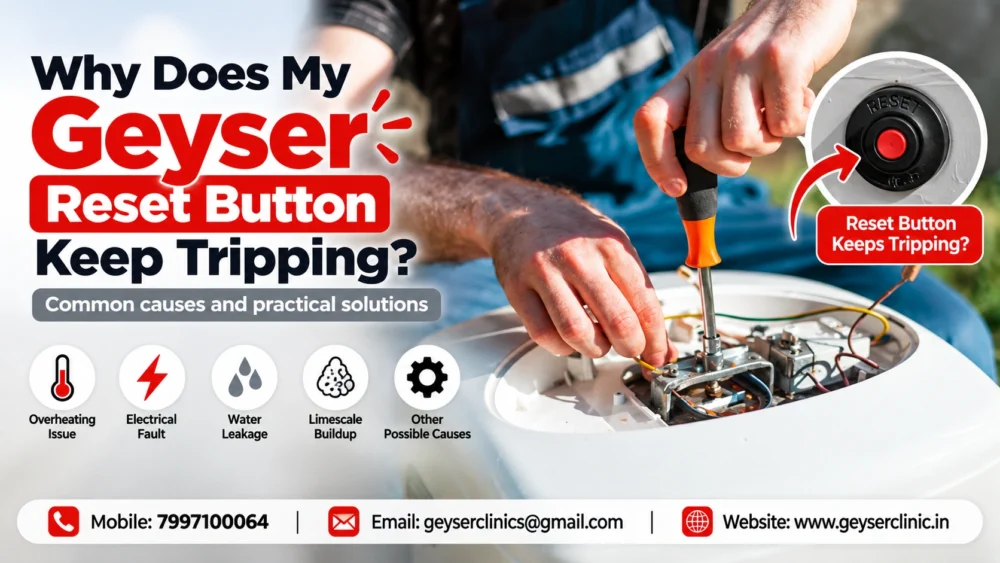
Why Does My Geyser Reset Button Keep Tripping?
If your electric geyser’s reset button keeps tripping, the button is usually not the underlying problem. It is a safety mechanism designed to interrupt heating when the water heater detects an abnormal temperature condition.
Repeated tripping can be associated with a faulty thermostat, overheating, a heating-element problem, electrical wiring issues, excessive sediment or scale, or another control or safety fault. The exact cause needs to be diagnosed rather than simply resetting the button each time.
For homeowners searching for a Geyser repair center in BHEL, understanding why the reset button operates can help you recognize when a simple observation is enough and when professional inspection is necessary.
Quick Answer: Why Does a Geyser Reset Button Keep Tripping?
A geyser reset button may repeatedly trip because of:
- A malfunctioning thermostat
- Overheating or abnormal temperature rise
- A faulty heating element
- A thermal safety cutoff operating correctly because another fault exists
- Damaged or overheated electrical connections
- Heavy scale or sediment buildup
- A control or sensor problem on applicable electronic models
- Incorrect electrical installation or another appliance-side fault
The reset button itself should not be treated as the diagnosis.
If it trips once, there may have been a temporary abnormal condition. If it keeps tripping, the underlying cause should be investigated.
What Is the Geyser Reset Button?
Many electric storage water heaters use a high-temperature safety cutoff, sometimes referred to as an ECO or resettable thermal safety device.
Its purpose is different from normal temperature regulation.
The thermostat controls normal heating operation. The high-temperature safety cutoff provides additional protection if the water temperature rises beyond the permitted range.
For example, A. O. Smith explains that its ECO is a safety device that can interrupt power to the heating elements when an excessive-temperature condition occurs. The manufacturer also notes that repeated ECO operation can be associated with thermostat or heating-element problems.
That means a repeatedly tripping reset button should be treated as a warning that requires investigation, not as an inconvenience to bypass.
Reset Button vs MCB: Are They the Same?
No.
This is an important distinction.
Geyser reset button
The reset button is associated with the water heater’s temperature safety protection. It can interrupt heating when an excessive-temperature condition is detected.
MCB
The Miniature Circuit Breaker (MCB) protects the electrical circuit against abnormal current conditions such as overloads or short-circuit conditions.
Therefore:
Reset button repeatedly trips → investigate temperature/control/heating-system problems.
MCB repeatedly trips → investigate electrical circuit/appliance electrical problems.
Sometimes both can occur, but they should not automatically be treated as the same fault.
1. A Faulty Thermostat Is a Major Possibility
The thermostat regulates the temperature of the water by controlling the heating cycle.
If the thermostat fails to regulate temperature correctly, the heating element may continue operating when it should stop. This can allow the water temperature to rise excessively and activate the safety cutoff.
Possible clues include:
- Reset button trips repeatedly.
- Water becomes unusually hot.
- Heating behavior becomes inconsistent.
- The geyser shuts down before normal operation is completed.
- Resetting temporarily restores heating but the problem returns.
However, a tripping reset button does not prove that the thermostat is defective. A technician should test the thermostat and associated components.
2. The Heating Element May Be Contributing to the Problem
The heating element is responsible for heating the water.
A damaged element can create abnormal operating conditions. In some water heaters, a faulty element can also contribute to overheating or cause the safety protection to operate.
An element problem becomes more relevant when the geyser has previously shown:
- Slow heating
- Unusual heating noises
- Inconsistent water temperature
- Reduced hot-water performance
- Repeated safety shutdowns
Sediment or mineral buildup around heating components can also affect water-heater performance.
A technician should establish whether the element itself is faulty before replacing it.
3. Heavy Scale or Sediment Can Affect Heating Performance
Mineral deposits can accumulate inside storage water heaters, particularly where the water contains significant amounts of hardness minerals.
Sediment can interfere with normal heat transfer and contribute to abnormal heating behavior. Manufacturer information also identifies sediment accumulation as a factor in water-heater performance and deterioration.
You may notice:
- Longer heating times
- Popping or rumbling sounds
- Fluctuating hot-water temperature
- Reduced heating performance
- More frequent safety shutdowns
But scale should remain a possible contributing factor, not an automatic diagnosis for every reset-button problem.
4. Electrical Connections May Need Inspection
The reset button can operate because of a temperature problem, but electrical components still need to be considered during diagnosis.
Possible concerns include:
- Damaged internal wiring
- Overheated terminals
- Loose electrical connections
- Incorrect installation
- Deteriorated insulation
- Control-component problems
Do not remove the geyser’s electrical cover to inspect these yourself.
A water heater combines electricity, heating components and pressurized water. Internal electrical diagnosis should be performed by an appropriately qualified technician.
5. A Sensor or Electronic Control Could Be Involved
Modern geysers may use electronic controls and temperature sensors rather than only traditional mechanical thermostats.
If a sensor sends incorrect temperature information or a control component malfunctions, the heating cycle may behave abnormally.
This is particularly relevant if your geyser has:
- A digital display
- Temperature buttons
- Error codes
- Electronic indicators
- Programmable temperature controls
In such cases, the exact model and fault code can be useful information for diagnosis.
What Does the Timing of the Reset Tell You?
The timing can provide a technician with valuable diagnostic clues.
Symptom pattern | What it may indicate |
Reset trips soon after heating begins | Heating/control problem may need investigation |
Reset trips after the geyser becomes very hot | Thermostat, heating element or temperature-control issue may be involved |
Reset trips repeatedly after manual reset | Underlying fault remains unresolved |
Reset stays stable but MCB trips | Electrical circuit/appliance fault needs investigation |
Geyser becomes unusually hot before shutdown | Possible temperature-control problem |
Geyser heats slowly and later trips | Scale, element deterioration or control problem may be involved |
These patterns are diagnostic clues, not confirmed faults.
What Should I Do When the Reset Button Trips?
You can make a few safe observations without opening the appliance.
Safe checks
- Turn the geyser off using its normal external control.
- Allow the appliance to cool.
- Note whether the reset button trips again during normal operation.
- Observe whether the water became unusually hot.
- Check for visible leakage around the geyser.
- Note any unusual sounds.
- Record any error code shown on a digital model.
- Check whether the MCB is also tripping.
If the button repeatedly trips, do not keep resetting it as a routine workaround.
Avoid these actions
Do not:
- Bypass the safety cutoff.
- Hold the reset button down.
- Modify thermostat wiring.
- Short or bridge safety components.
- Open the electrical compartment without appropriate expertise.
- Continue operating a geyser that shows signs of electrical overheating or serious leakage.
The purpose of the safety device is to interrupt heating under an abnormal condition. Defeating that protection can create a serious hazard.
How Does a Technician Diagnose a Repeatedly Tripping Reset Button?
A proper diagnosis should identify why the safety device is operating, not merely restore the button.
Step 1: Understand the symptom
The technician asks when the reset operates and what happened immediately beforehand.
Step 2: Check temperature-control components
The thermostat and applicable temperature-control system are assessed.
Step 3: Evaluate the heating element
The heating element is checked for appropriate electrical operation and possible faults.
Step 4: Inspect for scale and sediment
The internal condition may be evaluated where service access and the geyser design permit.
Step 5: Check electrical connections
Relevant wiring and connections are inspected for overheating, damage or installation-related problems.
Step 6: Consider electronic controls
For digitally controlled geysers, sensors, control boards and error indications may need assessment.
Step 7: Check for water-side problems
Leakage, abnormal pressure, corrosion or other water-system conditions may also be relevant.
Step 8: Recommend the appropriate repair
Only after diagnosis should the technician determine whether the required solution involves a thermostat, heating element, electrical repair, control component, cleaning/service or another repair.
Can High Water Pressure Cause the Reset Button to Trip?
Water pressure and temperature protection are related safety considerations, but they are not the same thing.
A geyser’s temperature-and-pressure safety system is designed to protect against unsafe conditions. If you notice water escaping from a relief valve, it should not automatically be assumed that the reset button is the cause.
The home’s water pressure, pressure-reducing equipment where applicable, thermal expansion and the condition of the relief valve can all matter.
This is why the related topic “What Water Pressure Is Normal for a Home Geyser?” is useful for understanding pressure-related symptoms separately from electrical temperature protection.
Never block or disable a pressure-relief discharge path.
Why Is Brown Water Coming From My Geyser?
Brown, yellowish or rusty-looking water can have several possible causes, including corrosion, sediment or plumbing-related issues.
Brown water does not automatically mean that the reset button is faulty.
However, if brown water occurs together with:
- Repeated reset-button trips
- Leakage
- Corrosion
- Unusual heating
- Metallic-looking particles
the geyser should be professionally assessed.
The related article “Why Is Brown Water Coming From My Geyser?” can be internally linked here because it addresses a different but relevant symptom.
How Often Should a Home Geyser Be Serviced?
There is no single service interval suitable for every home geyser.
The appropriate maintenance schedule can depend on:
- Water quality
- Household usage
- Geyser design
- Manufacturer recommendations
- Age of the appliance
- Scale and sediment conditions
- Installation environment
Routine inspection can help identify developing problems such as corrosion, leakage, sediment accumulation and deteriorating components.
But if the reset button is already tripping repeatedly, don’t wait for routine servicing. The immediate issue needs diagnosis.
When Does a Reset Button Problem Require Urgent Attention?
Arrange professional inspection if:
- The reset button trips repeatedly.
- The geyser becomes unusually hot.
- The MCB also trips.
- You notice a burning smell.
- Water is leaking near electrical components.
- The geyser produces unusual sounds.
- Brown/rust-colored water appears together with other faults.
- An electronic geyser displays an error code.
- Resetting the button only restores operation temporarily.
If there is visible electrical damage, significant water leakage near electrical components, burning odor or another immediate safety concern, switch the appliance off using the normal safe control if possible and avoid further operation until it has been inspected.
Can the Geyser Be Repaired or Does It Need Replacement?
A repeatedly tripping reset button does not automatically mean the entire geyser needs replacement.
Repair may be possible when the underlying issue is a serviceable component such as a thermostat, heating element, connection or control component.
Replacement may become a consideration when the tank itself is severely corroded, leaking, structurally compromised or when the overall appliance condition makes repair impractical.
The decision should be based on the actual condition of the geyser, not simply the fact that the reset button trips.
For customers concerned about repair expenses, the related guide “How Much Does Geyser Repair Cost in Hyderabad? Customer Guide” can be used as an internal link. Actual repair cost depends on the diagnosed fault, parts, appliance condition and service requirements.
Preventing Repeated Geyser Safety Trips
You cannot prevent every component failure, but you can reduce the chance of ignoring early warning signs.
- Don’t ignore repeated reset-button trips.
- Address unusually hot water promptly.
- Investigate slow heating or unusual noises.
- Have visible leakage checked.
- Follow the manufacturer’s maintenance recommendations.
- Keep electrical installation and protection appropriate for the appliance.
- Address scale and sediment when required.
- Do not bypass safety devices.
- Have older or repeatedly malfunctioning geysers inspected.
The most useful prevention rule is simple:
If a safety device repeatedly operates, find out why it is operating.
Geyser Repair Center in BHEL — Local Service Support
If your geyser reset button keeps tripping, GEYSER CLINIC can help identify whether the symptom is associated with the thermostat, heating element, temperature protection, electrical system, scale, leakage or another component.
Service support can be relevant for customers in:
- BHEL
- Beeramguda
- Lingampally
- Ramachandrapuram
- Chandanagar
When contacting a technician, mention whether the reset button trips immediately, after heating begins, after the water becomes hot, or repeatedly after resetting. That information can make the initial diagnosis more focused.
Reset Button Keeps Tripping? Give the Technician the Right Clues
Instead of repeatedly pressing the reset button, make a short note of when it trips, how hot the water was, whether the MCB also tripped, and whether there was leakage or unusual noise.
That small amount of information can help GEYSER CLINIC focus the inspection on the actual symptom.
GEYSER CLINIC
Mobile: 79971 00064
Email: geyserclinics@gmail.com
Related Geyser Topics
Use these supporting articles as contextual internal links:
- What Water Pressure Is Normal for a Home Geyser? — for pressure and relief-valve questions.
- Why Is Brown Water Coming From My Geyser? — for corrosion, sediment and water-color symptoms.
- How Much Does Geyser Repair Cost in Hyderabad? Customer Guide — for repair-cost considerations after diagnosis.
- Why Does a Geyser Overheat? Warning Signs and Safety Steps — useful from the thermostat and overheating sections.
Frequently Asked Questions
Why does my geyser reset button keep tripping?
Repeated reset-button operation can be associated with a thermostat problem, overheating, heating-element fault, scale buildup, electrical issues or another temperature-control problem. The actual cause requires diagnosis.
Is the geyser reset button the same as the MCB?
No. The reset button is associated with the water heater’s temperature safety protection, while an MCB protects the electrical circuit against abnormal current conditions.
Can a faulty thermostat make the reset button trip?
Yes. If a thermostat fails to regulate temperature correctly, the water can become excessively hot and activate the high-temperature safety cutoff. However, the thermostat should be tested before it is identified as the cause.
Can a heating element cause the reset button to trip?
It can contribute to abnormal heating or other faults in some water heaters. Proper testing is necessary to determine whether the element is actually defective.
Should I keep resetting the geyser?
No. If the safety button repeatedly trips, resetting it over and over only restores operation temporarily without addressing the underlying condition.
Can hard water cause the reset button to trip?
Hard water can contribute to scale and sediment accumulation, which can affect heating performance. It should be considered as a possible contributing factor, not assumed to be the confirmed cause.
Does a tripping reset button mean I need a new geyser?
Not necessarily. A faulty thermostat, heating element, connection or control component may be repairable. Replacement depends on the overall condition of the appliance and tank.
Why is my geyser both tripping the reset button and giving brown water?
The two symptoms may have separate causes, but corrosion or sediment could be relevant to the overall condition of the water heater. Professional inspection can determine whether they are connected.
Why does my geyser overheat and then trip?
A thermostat/control problem, heating-element issue, sensor fault or another abnormal condition may cause excessive temperature and activate the safety cutoff. The safety device should not be bypassed.
Conclusion
A geyser reset button is there to protect the water heater when an abnormal temperature condition occurs. If it trips repeatedly, the correct response is not to keep pressing it—it is to determine why the safety system is operating.
Possible causes include a thermostat fault, heating-element problem, overheating, scale or sediment, electrical connection issue, sensor/control fault or another appliance condition.
Start with safe external observations, note the timing and symptoms, and avoid opening or modifying the geyser’s electrical or safety components.
For homeowners searching for a Geyser repair center in BHEL, GEYSER CLINIC can provide diagnosis and repair-related assistance across BHEL, Beeramguda, Lingampally, Ramachandrapuram and Chandanagar.