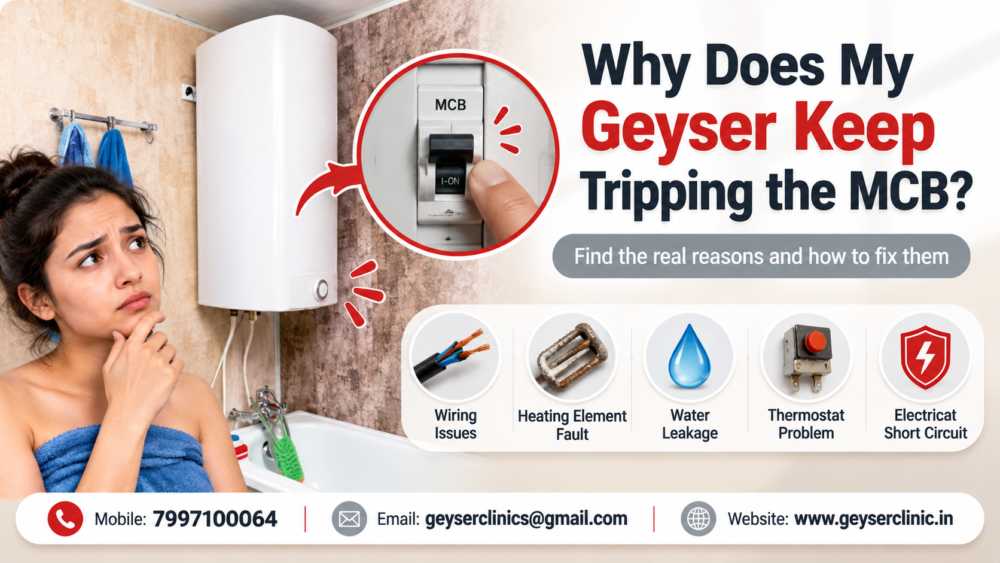
Why Does My Geyser Keep Tripping the MCB?
If your electric geyser keeps tripping the MCB whenever you switch it on or while it is heating, do not treat the breaker as the problem by itself. An MCB trip is a protective response to an electrical condition that needs to be identified.
Possible causes include a faulty heating element, damaged wiring, loose electrical connection, incorrect circuit protection, a defective MCB, thermostat/control problems, or another electrical fault inside the geyser. A technician should determine which condition is actually present before a repair is recommended.
For homeowners looking for a Geyser repair center in Begumpet, understanding why the MCB trips can help you take the right first step without putting yourself at electrical risk.
Quick Answer: Why Does a Geyser Keep Tripping the MCB?
A geyser may repeatedly trip the MCB because of:
- A faulty or electrically grounded heating element
- Damaged, overheated or loose wiring
- A problem with the geyser’s thermostat or control system
- An MCB that is defective or incorrectly selected for the circuit
- An electrical connection problem between the geyser and supply
- Moisture or leakage affecting electrical components
- An internal appliance fault
- Installation or circuit problems
A single trip does not automatically prove that the geyser itself is defective. The fault may be in the appliance, its electrical connection or the home’s protective circuit.
Manufacturer troubleshooting information lists circuit-breaker trips, improper wiring and heating-element faults among conditions associated with electric water-heater problems.
First: What Does an MCB Trip Actually Mean?
An MCB (Miniature Circuit Breaker) is designed to interrupt an electrical circuit when the current or electrical condition exceeds what the circuit can safely handle.
So when the geyser causes the MCB to trip, the breaker is often responding to a problem rather than causing it.
This distinction matters.
For example, repeatedly replacing or resetting the breaker without finding the underlying fault does not solve a grounded heating element, damaged wiring or another electrical problem.
MCB trip vs geyser safety cutoff
These are not the same thing.
MCB trip:
An electrical protective device interrupts the circuit.
Thermal safety cutoff/ECO:
A protection mechanism inside applicable water heaters can interrupt heating when an excessive-temperature condition is detected.
A water heater manufacturer notes that an ECO can trip when water becomes excessively hot and that a tripped ECO can be associated with thermostat or heating-element problems.
1. A Faulty Heating Element Can Trip the MCB
One of the important possibilities is a damaged or grounded heating element.
The heating element converts electrical energy into heat. If its electrical insulation deteriorates and the element develops an unwanted path to ground, the electrical behavior of the appliance can become abnormal and protective devices may trip.
You may notice a pattern such as:
- The geyser works for a while and then trips.
- The MCB trips specifically when heating begins.
- The geyser previously became slower at heating.
- There may have been unusual heating noises before the fault.
- Resetting the MCB provides only temporary operation.
A grounded heating element is only one possible diagnosis. It should be confirmed through appropriate electrical testing rather than assumed from the symptom alone.
2. Damaged or Loose Wiring Can Cause Repeated Trips
Electrical wiring supplying the geyser must be correctly sized, connected and protected.
A loose terminal, damaged cable, overheated connection or deteriorated insulation can create an electrical fault.
Potential warning signs include:
- Burning smell
- Discoloration near a switch or connection
- Buzzing or crackling
- Heat around an electrical connection
- MCB trips when the geyser starts
- Intermittent operation
Do not open the geyser’s electrical compartment or attempt to tighten internal terminals yourself.
Working around an energized water heater can cause serious electric shock or burns. Manufacturer guidance specifically warns against homeowner repair of electrical wiring and other internal electrical components.
3. The MCB Itself May Be Faulty or Incorrectly Selected
The geyser is not necessarily responsible for every MCB trip.
The protective device itself may be defective, or the circuit may have been incorrectly designed or modified.
For example, the electrical installation may need to be evaluated for:
- Appropriate circuit protection
- Correct cable sizing
- Connection quality
- Circuit loading
- Breaker condition
- Isolation arrangement
- Appliance electrical requirements
The solution is not simply to install a larger MCB.
A higher-rated breaker should not be used as a shortcut to stop nuisance tripping without determining whether the wiring and appliance are suitable for it.
4. Moisture or Water Leakage Can Create an Electrical Concern
Water and electricity are a dangerous combination.
If the geyser has developed a leak near electrical components, wiring or connections, continued operation should not be treated as normal.
Look for external warning signs such as:
- Water collecting below the geyser
- Leakage around connections
- Dampness near electrical controls
- Corrosion around fittings
- Water dripping from an unexpected location
If water is reaching an electrical area, switching the geyser on repeatedly to see whether it works can increase the risk.
Have the unit inspected professionally.
5. Thermostat or Control Problems Can Be Involved
The thermostat regulates the water temperature by controlling when heating operates.
A malfunctioning thermostat can cause abnormal heating behavior and, depending on the geyser’s design and fault condition, may contribute to safety-device operation or other electrical symptoms.
Modern geysers may also include electronic controls, sensors or relays.
For this reason, a technician should not automatically replace the heating element simply because the MCB is tripping.
The symptom identifies the electrical problem; testing identifies the failed component.
6. Could Hard Water or Scale Cause the MCB to Trip?
Hard water can contribute to scale and sediment buildup, which can affect water-heater performance.
Heavy buildup may reduce heat transfer and make the heating system work under less favorable conditions. Sediment is also recognized as a contributor to water-heater deterioration over time.
However, it would be inaccurate to say that every MCB trip is caused by hard water.
If your geyser has both slow heating and repeated electrical trips, scale may be part of the overall problem, but the electrical fault still needs proper diagnosis.
What Pattern Does the MCB Follow?
The timing of the trip can provide useful diagnostic information.
What happens | What it may suggest |
MCB trips immediately when geyser is switched on | Possible short circuit, wiring fault or appliance electrical fault |
MCB trips when heating starts | Heating element or related electrical fault may need investigation |
MCB trips after several minutes | Component may be developing a fault as it heats |
MCB trips randomly | Wiring, breaker, connection or intermittent appliance fault may be involved |
MCB trips even when geyser is not being used | The fault may be elsewhere in the circuit |
MCB stays on but geyser does not heat | Heating element, thermostat, control or supply problem may be involved |
These are diagnostic clues, not confirmed diagnoses.
What Can I Safely Check at Home?
You should limit yourself to external observations.
Safe checks
- Turn the geyser off using its normal external control.
- Observe whether the MCB remains stable with the geyser switched off.
- Note exactly when the MCB trips.
- Check for visible water leakage.
- Look for burning smells or visible scorching around accessible external switches.
- Check whether other electrical appliances are also experiencing problems.
- Note any error code or unusual display on an electronic geyser.
- Record whether the trip happens immediately or only after heating begins.
What you should NOT do
Do not:
- Open the electrical cover.
- Touch internal wires.
- Test live terminals yourself.
- Bypass the MCB.
- Replace the MCB with a higher rating simply to stop tripping.
- Bypass a thermostat or safety cutoff.
- Continue resetting the breaker repeatedly.
- Operate a leaking geyser when water may be reaching electrical components.
A.O. Smith and Rheem safety guidance warns that electrical water-heater troubleshooting can involve serious shock hazards and recommends qualified service for internal electrical repairs.
How Does a Technician Diagnose an MCB-Tripping Geyser?
A proper diagnosis should follow the sequence of the fault.
Step 1: Confirm the complaint
The technician establishes whether the MCB trips:
- Immediately
- When heating starts
- After several minutes
- Only occasionally
- Only with a particular operating condition
Step 2: Assess the electrical supply
The supply circuit, breaker, connections and appliance feed are evaluated according to the installation and geyser specifications.
Step 3: Check the heating system
The heating element is assessed for conditions such as an open circuit or unwanted electrical path to ground.
Step 4: Check temperature-control components
The thermostat, thermal protection and relevant controls are evaluated where applicable.
Step 5: Inspect for physical damage
The technician looks for signs of overheating, corrosion, water leakage, damaged connections or other deterioration.
Step 6: Separate appliance faults from installation faults
This is important. The geyser may be faulty, but the electrical circuit or breaker may also require attention.
Step 7: Recommend the appropriate repair
Only after the cause is established should the technician determine whether the solution involves an element, thermostat, wiring, control component, breaker/circuit issue, leakage repair or another repair.
Why Does My Geyser Keep Tripping After I Reset the MCB?
If the geyser works briefly after resetting the breaker but trips again, do not treat the temporary recovery as proof that the appliance is safe.
Repeated tripping means the underlying condition remains.
A heating element can develop a fault that becomes apparent during operation. Similarly, a loose connection, damaged wiring or control problem may produce intermittent symptoms.
The safest response is to stop repeatedly resetting the breaker and arrange an inspection.
How Does Geyser Overheating Relate to Electrical Problems?
Overheating and MCB tripping are related possibilities, but they are not interchangeable diagnoses.
An applicable geyser may have a temperature safety mechanism designed to interrupt heating if water becomes excessively hot. A faulty thermostat or heating element can contribute to an overheating condition, according to manufacturer troubleshooting information.
Warning signs that deserve attention include:
- Water becoming unusually hot
- Safety cutoff activation
- Repeated shutdowns
- Unusual heating behavior
- Pressure-relief discharge
- Burning smell or electrical overheating
If you suspect overheating, do not bypass the safety system to keep the geyser operating.
Can Geyser Overflowing Be Connected to This Problem?
A geyser that appears to be overflowing is a separate symptom that can sometimes involve pressure, temperature, inlet-water conditions, a safety/relief valve or another water-side problem.
If water is continuously escaping from a relief valve or another connection, the cause should be identified rather than simply blocking the outlet.
This is why the related topic “Why Does My Geyser Keep Overflowing With Water?” is useful as part of a broader geyser troubleshooting cluster.
A pressure-relief component is a safety device, not something that should be capped or disabled.
How Often Should a Home Geyser Be Serviced?
There is no single service interval that applies equally to every geyser.
Maintenance requirements depend on:
- Geyser design
- Water quality
- Household usage
- Manufacturer recommendations
- Age and condition of the appliance
- Local installation conditions
Routine inspection can help identify leaks, corrosion, sediment and deteriorating components before they become larger problems. The U.S. Department of Energy also emphasizes regular inspection and maintenance of water-using equipment to support reliability and prevent premature equipment problems.
If your geyser is already tripping the MCB, however, this should be treated as a fault diagnosis issue rather than simply waiting for the next scheduled maintenance visit.
Preventing Repeated Geyser MCB Trips
You cannot prevent every electrical failure, but you can reduce the chance of ignoring an emerging problem.
Practical prevention
- Have electrical installation checked when the geyser is installed or replaced.
- Follow the manufacturer’s electrical requirements.
- Do not ignore repeated MCB trips.
- Address visible leakage promptly.
- Have unusual heating behavior investigated.
- Keep the geyser maintained according to its design and manufacturer guidance.
- Address scale and sediment where appropriate.
- Replace deteriorated components rather than repeatedly resetting protection.
- Never bypass electrical or temperature safety devices.
Geyser Repair Center in Begumpet — Local Help for MCB-Tripping Problems
If your geyser repeatedly trips the MCB, the useful question is not simply “How do I stop the MCB from tripping?” The better question is “What electrical condition is causing the protection to operate?”
GEYSER CLINIC can help customers diagnose geyser-related electrical, heating, control and leakage symptoms in Begumpet and nearby areas including:
- Ameerpet
- Punjagutta
- Somajiguda
- Paradise
When contacting a technician, provide the timing of the trip and any other symptoms you have observed. This can make the diagnostic process more focused.
Need Help With a Geyser That Keeps Tripping the MCB?
Don’t keep resetting the breaker and hoping the geyser will continue working. Note when the trip occurs, switch the appliance off, and arrange a proper diagnosis.
GEYSER CLINIC
Mobile: 79971 00064
Email: geyserclinics@gmail.com
Related Geyser Topics
Build the internal-link cluster around the actual problem:
- Why Does My Geyser Keep Overflowing With Water? — useful from the leakage/pressure section.
- How Often Should a Home Geyser Be Serviced? — useful from the prevention section.
- Why Does a Geyser Overheat? Warning Signs and Safety Steps — useful from the overheating section.
These supporting articles can help users move from identifying a symptom to understanding related geyser safety and maintenance issues.
Frequently Asked Questions
Why does my geyser trip the MCB as soon as I switch it on?
An immediate trip can indicate a short circuit, electrical connection problem, appliance fault or another abnormal electrical condition. It should be diagnosed rather than repeatedly reset.
Why does the MCB trip only when the geyser starts heating?
If the breaker remains stable until the heating cycle begins, the heating element or another component that becomes energized during heating may need investigation.
Can a faulty heating element trip the MCB?
Yes. A damaged or grounded heating element can create an electrical fault that causes protective devices to operate. Proper testing is required to confirm this.
Can the MCB itself be faulty?
Yes. The breaker can be defective, but the appliance, wiring and circuit should also be checked before replacing it.
Should I replace the MCB with a higher-rated one?
No—not simply to stop the tripping. The breaker rating must be appropriate for the circuit, wiring and appliance requirements. Increasing the rating without checking the installation can create a safety problem.
Can hard water cause MCB tripping?
Hard water can contribute to scale and sediment buildup, which can affect water-heater performance. But hard water alone should not be assumed to be the cause of an MCB trip.
Is it safe to keep resetting the MCB?
Repeatedly resetting a breaker without finding the reason for the trip is not recommended. The underlying electrical condition should be investigated.
Does an MCB trip mean my geyser needs replacement?
Not necessarily. A repairable component, electrical connection, breaker or installation issue may be responsible. Replacement should be considered only after the actual condition of the appliance has been assessed.
Can a thermostat cause geyser safety problems?
A malfunctioning thermostat can interfere with temperature regulation and, in applicable water heaters, may contribute to an overheating condition that activates a safety cutoff.
Conclusion
A geyser that repeatedly trips the MCB is giving you an electrical warning, not simply a minor inconvenience.
The possible cause may be a heating-element fault, damaged wiring, thermostat/control problem, defective breaker, installation issue, moisture-related fault or another electrical condition. The timing of the trip provides useful clues, but it does not establish the diagnosis by itself.
The safest approach is to perform only basic external observations, avoid opening the electrical compartment, stop repeated breaker resets and have the appliance and its electrical supply professionally assessed.
For homeowners searching for a Geyser repair center in Begumpet, GEYSER CLINIC can assist with diagnosis and repair-related support across Begumpet, Ameerpet, Punjagutta, Somajiguda and Paradise.