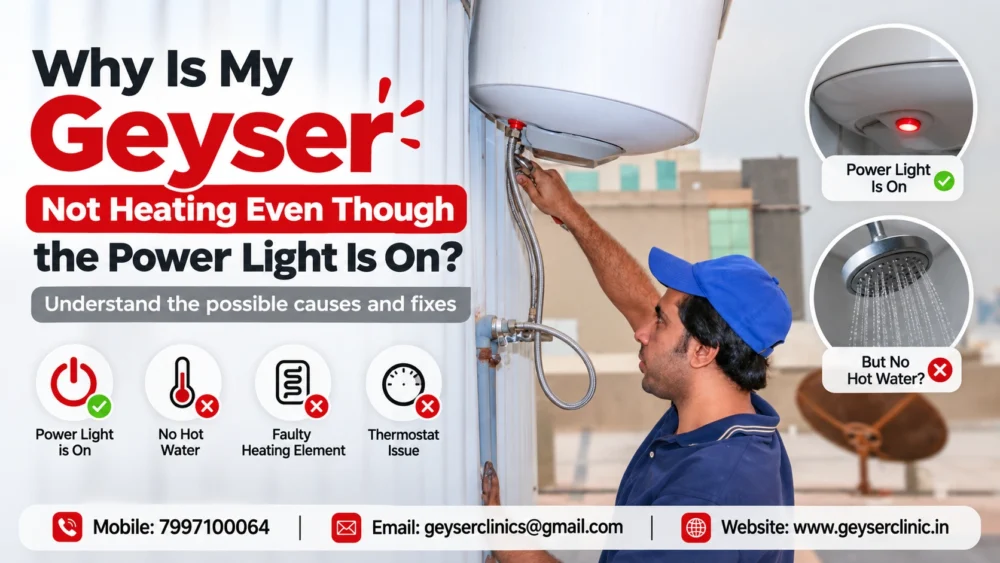
Why Is My Geyser Not Heating Even Though the Power Light Is On?
You switch on your geyser, the power light comes ON, but the water remains cold or only becomes slightly warm. This often makes homeowners assume that the electrical supply is working perfectly and the heating element must be the only problem.
That is not necessarily true.
A power indicator generally tells you that some part of the appliance is receiving electrical power; it does not by itself confirm that the heating element is actually heating the water. Depending on the geyser design, problems with the heating element, thermostat, thermal safety cutoff, internal wiring, control system, scale buildup or water-heating cycle can still result in cold water. Manufacturer troubleshooting information similarly lists failed elements, thermostats, safety cutoffs, wiring and other conditions among possible causes of no hot water.
If you are searching for a Geyser repair center in AS RAO Nagar, understanding these possibilities can help you identify the symptoms and know when professional diagnosis is appropriate. GEYSER CLINIC can assist customers in AS RAO Nagar and nearby ECIL, Kapra, Sainikpuri and Kushaiguda.
Quick Answer: Why Is the Power Light On but the Geyser Not Heating?
The most likely possibilities include:
- Failed or damaged heating element
- Faulty thermostat or temperature sensor
- Tripped thermal safety cutoff
- Internal electrical connection or wiring problem
- Excessive scale or mineral deposits
- A control-board or sensor problem in electronically controlled models
- Hot-water demand exceeding the geyser’s recovery capacity
- A plumbing issue that makes hot-water production appear inadequate
The exact cause cannot be confirmed simply by looking at the power light. A technician needs to diagnose the heating circuit and relevant components.
1. The Heating Element May Have Failed
The heating element is the component that converts electrical energy into heat and transfers that heat to the water.
If the element burns out or develops an electrical fault, the geyser can still appear powered while producing little or no hot water.
Common symptoms
You may notice:
- Power indicator is ON
- Water remains completely cold
- Heating takes much longer than before
- The geyser suddenly stopped producing hot water
- Previous heating performance had gradually declined
Electric water-heater troubleshooting guides identify a burned-out heating element as a possible cause of no hot water.
However, do not assume that every cold geyser needs a new element. The thermostat, safety cutoff and electrical circuit should also be checked.
2. The Thermostat May Not Be Controlling the Heating Cycle
A thermostat controls when the heating element switches on and off according to water temperature. Some storage water heaters use more than one thermostat or temperature-sensing component.
A thermostat-related problem can cause:
- Water that stays cold
- Lukewarm water
- Inconsistent heating
- Heating stopping before the desired temperature is reached
- The safety cutoff activating
This is why replacing the heating element without checking the control system can result in an incomplete or incorrect repair.
3. A Thermal Safety Cutoff May Have Interrupted Heating
Electric geysers incorporate temperature-limiting safety controls to help prevent excessive heating.
If a safety cutoff has opened, power to the heating element may be interrupted even though another indicator on the appliance remains illuminated. Some water-heater designs use an ECO (Energy Cut-Off) or similar temperature-limiting device.
A repeated safety cutoff is not something to ignore.
Important: Do not bypass or repeatedly reset an internal safety device yourself. The reason for the high-temperature condition needs to be investigated before the appliance is returned to normal operation.
4. The Power Light Does Not Prove the Heating Element Is Working
This is one of the most important points.
Think of the power light as an indicator of electrical status, not a complete heating diagnosis.
A simplified sequence is:
Power supply → controls/safety system → thermostat/control signal → heating element → heat transferred to water
A problem anywhere in the relevant heating circuit can prevent normal water heating.
Some advanced water heaters even use separate diagnostic indicators specifically to show heating-element operation, illustrating why a general power indicator and actual element operation are not necessarily the same thing.
5. Scale or Sediment May Be Affecting Heating Performance
Mineral deposits can accumulate around heating components and interfere with efficient heat transfer.
A geyser affected by scale may show:
- Slow heating
- Reduced hot-water output
- Unusual rumbling or heating noises
- Gradually declining performance
Manufacturer troubleshooting information identifies mineral or scale deposits on heating elements as a possible source of heating-related problems and unusual noises.
This is especially relevant when the geyser has not been maintained for a long time or operates with water conditions that promote mineral deposits.
Related guide
For a deeper maintenance approach, see:
What Should Be Included in a Geyser Maintenance Checklist?
This can be internally linked to a maintenance-focused service guide on your website.
6. The Geyser May Be Recovering After Heavy Hot-Water Usage
Not every “no hot water” complaint means a component has failed.
For example, suppose several people use hot water consecutively. The stored hot water can be depleted faster than the geyser can heat replacement water.
You may experience:
First user → hot water
Second user → warm water
Later user → insufficient hot water
Manufacturer troubleshooting guidance specifically lists hot-water demand exceeding heater capacity as one possible reason for insufficient or no hot water.
If the geyser returns to normal after adequate recovery time, the appliance may not have the same fault as a unit that remains cold continuously.
7. Internal Wiring or Electrical Connections May Be Faulty
A loose, damaged or incorrect electrical connection can prevent the heating circuit from operating normally.
Possible clues include:
- Power light behaves differently than usual
- Geyser stops heating intermittently
- Circuit protection trips
- Burning smell
- Visible electrical damage
- Heating works only occasionally
Do not remove the electrical cover or attempt to tighten internal terminals while the appliance is connected to power.
Water-heater manufacturers warn that working around energized electrical circuits can cause severe injury and recommend qualified service for electrical repairs.
8. Electronic Controls or Sensors Can Cause Heating Problems
Modern geysers may include electronic displays, sensors, control boards or diagnostic systems.
A sensor can provide incorrect temperature information, while a control-board fault can interfere with the heating sequence.
Depending on the model, you may see:
- Error codes
- Abnormal display behavior
- Heating that starts and stops unexpectedly
- Incorrect temperature readings
- Power indication without normal heating
The correct diagnostic procedure depends heavily on the geyser model, so the owner’s manual and model-specific service information should be consulted.
What Can You Safely Check Yourself?
Before arranging a service visit, homeowners can perform a few external, low-risk checks:
Check 1: Is the geyser actually switched on?
Look at the external switch or control panel and confirm its normal operating status.
Check 2: Has the circuit breaker tripped?
If the relevant breaker is visibly tripped, follow the manufacturer’s or electrician’s guidance. If it trips again, do not repeatedly reset it.
Check 3: Has the geyser had enough recovery time?
If several people have recently used hot water, allow the unit time to recover.
Check 4: Look for visible warning signs
Check externally for:
- Water leakage
- Burn marks
- Burning smell
- Unusual noises
- Error messages
- Damaged switches or cables
Check 5: Check the manufacturer’s controls
If your geyser has a digital display, check for an error code and refer to the model’s user manual.
Do not open the electrical cover, test live terminals, bypass the thermostat or safety cutoff, or attempt element replacement as a DIY procedure.
How Does a Technician Diagnose This Problem?
A professional diagnosis should distinguish between a symptom and a confirmed fault.
For a geyser with a power light ON but no hot water, the technician may assess:
External power → electrical protection → thermostat/control system → safety cutoff → heating element → wiring/connections → scale/sediment → plumbing-related issues
Electrical testing may be required to determine whether the heating element has an open or grounded circuit, whether the thermostat is functioning correctly, and whether the heating circuit is receiving the appropriate electrical supply.
Manufacturer documentation uses electrical test equipment for these checks and warns about the hazards of energized circuits.
What Is the Right Solution?
The solution depends on the confirmed fault.
Confirmed problem | Typical professional response |
Failed heating element | Inspect and replace the element if required |
Faulty thermostat | Test and replace the thermostat where appropriate |
Safety cutoff activated | Identify and correct the underlying cause before restoring operation |
Scale buildup | Assess and clean/service the affected components |
Wiring fault | Repair the electrical connection safely |
Control/sensor problem | Diagnose the model-specific electronic system |
Excessive hot-water demand | Allow recovery time or reassess usage/capacity |
Plumbing-related problem | Identify and correct the relevant plumbing issue |
This approach is preferable to replacing parts based solely on the fact that the power light is illuminated.
What Are the Warning Signs of Sediment Build-Up Inside a Geyser?
Common clues can include:
- Heating becoming progressively slower
- Rumbling, popping or unusual heating noises
- Reduced hot-water performance
- Repeated heating-related complaints despite normal power supply
- Visible signs of water-quality-related deposits during professional servicing
Scale is only one possible explanation, however. A technician should distinguish sediment or mineral buildup from an electrical or component failure.
This topic can naturally connect to your related article:
What Are the Warning Signs of Sediment Build-Up Inside a Geyser?
How Much Does Geyser Repair Cost in Hyderabad?
There is no single repair price that applies to every geyser problem.
The eventual cost can depend on factors such as:
- Geyser brand and model
- Faulty component
- Required replacement part
- Appliance capacity and design
- Condition of the existing installation
- Scale or corrosion
- Labour and service requirements
A thermostat replacement, heating-element replacement, wiring repair and general inspection are different jobs, so publishing one universal price can be misleading.
For an accurate estimate, diagnosis should come before quoting a component-specific repair.
When Should You Contact a Geyser Repair Professional?
Arrange professional inspection if:
- The power light is ON but water remains cold
- Heating has become unusually slow
- The MCB repeatedly trips
- You notice a burning smell
- There is electrical damage
- The geyser leaks
- A safety device repeatedly activates
- An error code appears
- The unit makes persistent unusual sounds
- The problem continues after normal recovery time
If electricity and water are involved, avoiding unnecessary DIY internal repairs is the safer approach.
Geyser Repair in AS RAO Nagar, ECIL and Nearby Areas
If your geyser has power but is not heating water, GEYSER CLINIC can help customers looking for a Geyser repair center in AS RAO Nagar with diagnosis-focused service.
The relevant service area includes AS RAO Nagar and nearby locations such as:
- ECIL
- Kapra
- Sainikpuri
- Kushaiguda
When requesting service, share the geyser brand, capacity, approximate age, whether the power light is ON, whether the water is completely cold or merely lukewarm, whether the MCB trips, and whether any error code appears.
These details can help the technician understand the symptom before inspection.
GEYSER CLINIC
Mobile: 79971 00064
Email: geyserclinics@gmail.com
How to Reduce the Risk of Future Heating Problems
A practical maintenance routine can help identify developing issues earlier.
- Follow the manufacturer’s recommended maintenance schedule.
- Have slow heating investigated rather than ignoring it.
- Watch for unusual heating noises.
- Check externally for leaks.
- Do not repeatedly reset a breaker that keeps tripping.
- Keep the geyser accessible for inspection.
- Have scale or sediment assessed when heating performance declines.
- Use the correct operating settings recommended for your model.
Regular maintenance is particularly useful because components such as heating elements, thermostats and safety devices can wear or fail independently.
Frequently Asked Questions
Why is my geyser not heating even though the power light is on?
The power light does not confirm that the heating element is operating. Possible causes include a failed heating element, thermostat fault, safety cutoff, wiring problem, scale buildup or control-system fault.
Does a power light mean the geyser is receiving enough power?
Not necessarily. The indicator may show an electrical status condition, but proper heating depends on the complete heating circuit and controls.
Why is my geyser producing only lukewarm water?
Possible causes include a partially failed heating system, thermostat/control problems, scale buildup, heavy hot-water demand or a plumbing issue. The exact cause requires diagnosis.
Can a heating element fail suddenly?
Yes. Heating elements wear components and can fail abruptly. A sudden loss of heating does not automatically mean another component is unaffected.
Can sediment cause a geyser to stop heating?
Heavy mineral deposits can reduce heating efficiency and affect performance. However, a completely cold geyser may also have an electrical or component fault, so sediment should not be assumed without inspection.
Should I reset the geyser’s internal safety cutoff myself?
No. If an internal safety device has been activated, the underlying cause should be investigated. Do not bypass or repeatedly reset safety controls.
How much does geyser repair cost in Hyderabad?
It depends on the confirmed fault, model, replacement part and service requirements. A diagnosis is more reliable than assuming a fixed price before identifying the problem.
Where can I get geyser repair in AS RAO Nagar?
Customers searching for a Geyser repair center in AS RAO Nagar can contact GEYSER CLINIC for assistance with diagnosing heating problems. Nearby areas include ECIL, Kapra, Sainikpuri and Kushaiguda.
Related Topics for Internal Linking
Create a connected topical cluster around this article with:
- What Should Be Included in a Geyser Maintenance Checklist?
Anchor: geyser maintenance checklist - What Are the Warning Signs of Sediment Build-Up Inside a Geyser?
Anchor: warning signs of geyser sediment buildup - How Much Does Geyser Repair Cost in Hyderabad? Customer Guide
Anchor: geyser repair cost in Hyderabad - Main local service page
Anchor: Geyser repair center in AS RAO Nagar - Local supporting pages
Anchors such as geyser repair in ECIL, geyser repair in Kapra, geyser service in Sainikpuri and geyser repair in Kushaiguda, provided those pages actually exist.
A Simple Diagnostic Rule
If the power light is ON but the water is cold, don’t jump straight to “the heating element is bad.”
The light confirms only part of the story. The heating element, thermostat, safety cutoff, wiring, control system, scale buildup and water usage pattern can all produce similar symptoms.
Start with safe external checks. If the problem persists—or involves electrical components, repeated breaker trips, leakage, burning smells or safety-device activation—professional diagnosis is the appropriate next step.
Need Help With a Geyser That Has Power but No Hot Water?
Instead of replacing a part based on a guess, give the technician the actual symptoms: power light ON, water cold/lukewarm, heating time, unusual sounds, error codes and breaker behavior. That information makes the service visit more focused.
For customers in AS RAO Nagar, ECIL, Kapra, Sainikpuri and Kushaiguda, GEYSER CLINIC can be contacted for geyser diagnosis and repair assistance.
GEYSER CLINIC — Mobile: 79971 00064 | Email: geyserclinics@gmail.com