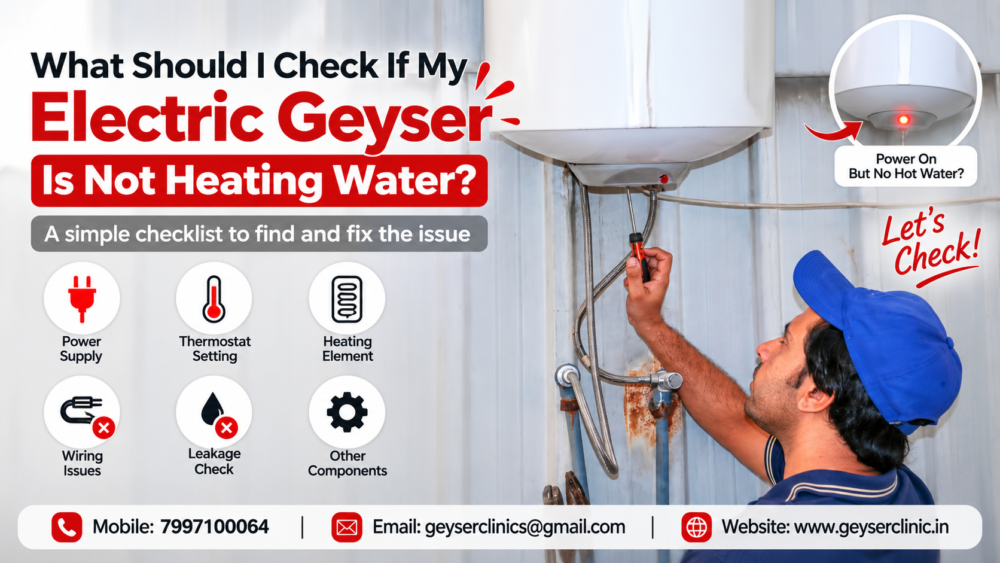
What Should I Check If My Electric Geyser Is Not Heating Water?
An electric geyser that suddenly stops heating can leave you wondering whether the heating element, thermostat, power supply or entire appliance has failed. Before assuming that a major repair is needed, it helps to identify exactly what the geyser is doing.
If the power indicator is ON but the water remains cold, the appliance may still have a problem somewhere in its heating circuit. If the indicator is OFF, the issue may instead involve the electrical supply or protection device.
For homeowners searching for a Geyser repair center in Attapur, the safest approach is to start with simple external checks and leave internal electrical diagnosis to a qualified technician.
GEYSER CLINIC can assist customers in Attapur, Mehdipatnam, Tolichowki, Rajendra Nagar and Upparpally with geyser-related diagnosis and repair requirements.
Quick Answer: What Should You Check First?
If your electric geyser is not heating water, check these points in order:
- Is the geyser receiving power?
- Is the external switch in its normal ON position?
- Has the relevant MCB or circuit protection tripped?
- Has the geyser had enough time to heat the water?
- Is the problem no hot water, lukewarm water or slow heating?
- Are there unusual noises, leaks, burning smells or error codes?
- Has the geyser recently been serviced or maintained?
- Could the heating element, thermostat or safety cutoff have failed?
These are possible causes—not confirmed diagnoses. Manufacturer troubleshooting information for electric water heaters similarly identifies power supply, circuit protection, thermostat issues, heating elements, wiring, safety cutoffs, water demand and mineral deposits among possible causes of inadequate or absent hot water.
1. First Identify the Exact Symptom
“Geyser not heating” can mean several different things.
Completely cold water
If the water remains cold even after the normal heating period, possible causes include:
- Heating element failure
- Thermostat or temperature-control fault
- Safety cutoff activation
- Electrical supply or wiring problem
- Electronic control fault on applicable models
Lukewarm water
If the water becomes warm but never reaches the expected temperature, possible causes include:
- Heating-element deterioration
- Thermostat/control problem
- Scale or mineral deposits
- High hot-water demand
- A temperature-control setting or sensor issue
Heating takes much longer than before
Gradually slower heating may point toward scale buildup, a deteriorating heating element, changing water conditions or another component problem.
A sudden failure and a gradual decline can therefore point toward different diagnostic paths.
2. Check the External Power Supply
Start with what you can safely observe from outside the appliance.
Check whether:
- The home’s electricity is available.
- The geyser’s external switch appears to be ON.
- The normal power indicator is illuminated.
- The relevant circuit breaker appears to have tripped.
If the breaker repeatedly trips, do not keep resetting it. Repeated tripping can indicate an electrical fault that needs inspection.
Do not remove the geyser’s electrical cover or touch internal terminals to investigate the problem yourself.
Manufacturer guidance specifically cautions against homeowner repair of electrical wiring, heating elements, temperature sensors and safety devices.
3. Don’t Assume the Heating Element Is the Problem
The heating element is responsible for converting electrical energy into heat, so it is an obvious suspect when a geyser stops producing hot water.
However, an element can only heat when the relevant control and electrical circuit allow it to operate.
A simplified heating sequence is:
Electrical supply → thermostat/control → safety system → heating element → heat transferred to water
A fault anywhere along this path can produce a similar “no hot water” symptom.
Heating elements can fail abruptly, while thermostats can also fail and prevent proper temperature regulation.
What may suggest an element problem?
- Water remains completely cold.
- The geyser previously worked normally and suddenly stopped heating.
- Heating performance has progressively deteriorated.
- The appliance has an applicable diagnostic indicator showing an element fault.
Some modern electric water heaters provide specific diagnostic indicators for heating-element operation, demonstrating why a general power indicator does not necessarily prove that the element is functioning.
Only appropriate electrical testing can confirm an element fault.
4. Consider the Thermostat
The thermostat controls the heating cycle by responding to water temperature.
Depending on the geyser design, a thermostat problem can cause:
- No heating
- Insufficient heating
- Heating that stops too early
- Temperature fluctuations
- Excessive heating followed by safety shutdown
Some electric storage water heaters use upper and lower thermostats, while electronically controlled models may use temperature sensors and control boards instead.
That is why the exact geyser model matters when diagnosing a heating problem.
5. Could the Safety Cutoff Have Activated?
Electric geysers incorporate temperature-limiting safety controls.
If the system detects an excessively high temperature, a safety control can interrupt power to the heating element. On applicable models, this may be called an ECO or high-limit cutoff.
A safety cutoff should not simply be treated as a button that needs resetting.
The reason it activated should be investigated.
Do not bypass the safety device or open the appliance to reset internal components unless the procedure is specifically intended for the user and can be performed safely according to the manufacturer’s instructions. Manufacturer documentation warns that the underlying high-temperature condition should be investigated before returning the heater to service.
6. Check Whether the Geyser Has Simply Run Out of Hot Water
Sometimes the geyser is functioning normally.
For example, if several people use hot water consecutively, the stored hot-water supply can be depleted before the heater has recovered.
This can look like a fault:
First user → hot water
Second user → warm water
Later user → insufficient hot water
Manufacturer troubleshooting guidance lists excessive hot-water usage and insufficient recovery time as possible reasons for inadequate hot water.
If the geyser produces hot water normally after sufficient recovery time, the issue may be related to demand rather than a failed component.
7. Look for Scale or Sediment-Related Symptoms
Mineral deposits can accumulate around heating components and affect heating efficiency.
Possible clues include:
- Heating becomes progressively slower
- Rumbling or unusual heating noises
- Reduced hot-water performance
- Repeated heating complaints despite apparently normal power
Manufacturer documentation specifically associates scale or mineral deposits on heating elements with rumbling noises.
Scale should not automatically be blamed for a completely cold geyser, though. A technician should distinguish between sediment buildup and an electrical/component failure.
Related topic
This is a natural place to internally link to:
Why Is Brown Water Coming From My Geyser?
Brown or discolored water can have different causes, including corrosion or water-quality-related issues, and should not automatically be attributed to the heating element.
8. Check for Water Leaks and Unusual Signs
While inspecting the appliance externally, look for:
- Water around the geyser
- Dampness around pipe connections
- Corrosion or visible deterioration
- Burning smell
- Burn marks
- Unusual sounds
- Error codes or abnormal display messages
If there is significant leakage, electrical damage, a burning smell or repeated electrical tripping, stop using the appliance and arrange professional inspection.
Do not attempt to open or repair electrical components while the geyser is energized.
What Can You Safely Check at Home?
A homeowner can usually make these low-risk observations without opening the appliance:
Check | What it can tell you |
Power available in the home | Rules out a general outage |
External geyser switch | Confirms normal external switch position |
Indicator light/display | Provides an initial operating clue |
Circuit breaker | May reveal an electrical protection event |
Heating time | Helps distinguish normal recovery from slow heating |
Hot vs lukewarm vs cold water | Helps describe the symptom |
Error code | Can provide model-specific diagnostic information |
Leakage or burning smell | Indicates need for professional attention |
Do not test live terminals, remove electrical covers, bypass safety devices or replace an element yourself unless you have the appropriate qualifications and equipment.
How Does a Technician Confirm the Fault?
A proper diagnosis goes beyond asking, “Is the light ON?”
A technician may evaluate:
Power supply → circuit protection → thermostat/control → safety cutoff → heating element → wiring → scale/sediment → water-flow or plumbing-related conditions
Depending on the model, electrical testing can be required to identify an open or grounded heating element, thermostat fault or control-system problem. Manufacturer technical documentation includes dedicated procedures for testing these components with electrical test equipment.
The purpose of diagnosis is to replace the failed component, not simply replace parts until the geyser starts working.
Common Problem → Possible Cause → Appropriate Action
Symptom | Possible cause | Appropriate next step |
Completely cold water | Element, thermostat, safety control or electrical fault | Professional diagnosis |
Lukewarm water | Element, thermostat, scale or high demand | Assess heating performance |
Very slow heating | Scale, element deterioration or control issue | Inspection/service |
MCB repeatedly trips | Electrical/appliance fault | Stop repeated resetting; arrange inspection |
Rumbling during heating | Possible scale/mineral deposits | Professional maintenance assessment |
Hot water runs out quickly | High demand, recovery or appliance issue | Check usage and diagnose if persistent |
Water leaking | Plumbing/tank/component issue | Professional inspection |
Remember: these are diagnostic possibilities, not confirmed faults.
Does an Electric Geyser Really Need Regular Servicing?
Routine maintenance can help identify developing problems such as scale buildup, component wear, corrosion or leakage before they become larger issues.
The exact maintenance requirements depend on the geyser design, manufacturer and local water conditions.
A sensible maintenance assessment may consider:
- Heating performance
- Electrical connections
- Heating element condition
- Thermostat/control operation
- Safety components
- Scale or sediment
- Visible leakage
- Corrosion and tank condition
Manufacturer technical resources note that routine maintenance and periodic inspections can help maintain water-heater performance and service life.
Should I Repair or Replace My Geyser?
A failed component does not automatically mean the entire geyser needs replacement.
The decision can depend on:
- Age and overall condition
- Tank condition
- Type and severity of the fault
- Availability of suitable replacement parts
- Previous repair history
- Corrosion or leakage
- Repair cost compared with replacement
- Whether the existing capacity still suits household demand
If the tank itself is in poor condition or has a significant structural leak, replacement may need to be considered. If the tank remains sound and the problem is an individual serviceable component, repair may be practical.
The decision should follow inspection rather than be based solely on the age of the appliance.
When Should You Call a Geyser Technician?
Professional diagnosis is appropriate when:
- The geyser remains cold after adequate heating time.
- The MCB repeatedly trips.
- The unit has a burning smell.
- There is water leakage.
- The safety cutoff repeatedly activates.
- Heating has become significantly slower.
- The geyser produces inconsistent temperatures.
- An error code appears.
- Internal electrical components need testing.
- You are unsure whether the problem is the element, thermostat or control system.
Geyser Repair in Attapur and Nearby Areas
If your electric geyser is not heating and basic external checks have not identified the reason, GEYSER CLINIC can assist customers searching for a Geyser repair center in Attapur.
Service enquiries can also come from nearby:
- Mehdipatnam
- Tolichowki
- Rajendra Nagar
- Upparpally
When contacting GEYSER CLINIC, share the brand, model if available, capacity, approximate age, symptom, indicator status, heating time, error code and whether the MCB trips.
That information can help the technician understand the problem before inspecting the appliance.
GEYSER CLINIC
Mobile: 79971 00064
Email: geyserclinics@gmail.com
A Topic-Specific CTA: Before You Replace the Geyser, Find the Fault
If your geyser has stopped heating, don’t make the first decision a replacement decision.
First establish whether the problem is a heating element, thermostat, safety control, scale-related issue, electrical fault or simply insufficient recovery after heavy use.
For customers in Attapur, Mehdipatnam, Tolichowki, Rajendra Nagar and Upparpally, GEYSER CLINIC can help with the next step: identify the actual problem before deciding what needs to be repaired or replaced.
Call: 79971 00064
Email: geyserclinics@gmail.com
Frequently Asked Questions
What should I check first if my electric geyser is not heating?
Start with safe external checks: confirm power is available, check the external switch, observe the indicator/display, check whether the circuit breaker has tripped, and consider whether the geyser has had sufficient recovery time.
Why is my geyser not heating even though the switch is ON?
The switch being ON does not confirm that the complete heating circuit is functioning. A heating element, thermostat, safety cutoff, wiring or control-system fault can still prevent heating.
Can a heating element fail suddenly?
Yes. Electric heating elements can fail abruptly, even when the geyser appeared to be working normally beforehand.
How do I know whether the thermostat or heating element is faulty?
The symptoms can overlap, so visual inspection alone may not be enough. Appropriate electrical and component testing is generally required to confirm the fault.
Can sediment make my geyser heat slowly?
Yes. Mineral or scale deposits can affect heating performance and can contribute to unusual heating noises.
Does regular geyser servicing prevent all heating problems?
No maintenance program can prevent every component failure. However, appropriate inspection can help identify scale, wear, leakage and other developing issues earlier.
Should I repair or replace my geyser?
Consider the tank condition, fault type, appliance age, repair requirements, replacement-part availability and overall repair economics. A component failure does not automatically require complete replacement.
How much does geyser repair cost?
The cost depends on the confirmed fault, model, required part and service work. It is better to diagnose the problem before assuming a fixed repair price.
Where can I find a Geyser repair center in Attapur?
Customers in Attapur can contact GEYSER CLINIC for geyser diagnosis and repair assistance. Nearby service areas include Mehdipatnam, Tolichowki, Rajendra Nagar and Upparpally.
Related Topics for Internal Linking
Use these related articles to build a logical topical cluster:
- Why Is Brown Water Coming From My Geyser?
Suggested anchor: brown water from geyser - Does an Electric Geyser Really Need Regular Servicing?
Suggested anchor: electric geyser regular servicing - Should I Repair or Replace My Geyser? Factors to Consider
Suggested anchor: repair or replace a geyser - Main Attapur service page
Suggested anchor: Geyser repair center in Attapur - Supporting local pages, where they actually exist
Suggested anchors: geyser repair in Mehdipatnam, geyser repair in Tolichowki, geyser repair in Rajendra Nagar, geyser repair in Upparpally
Avoid linking every related article using the exact same anchor. Use descriptive anchors that match the destination page and the surrounding context.
Conclusion
An electric geyser that is not heating water does not automatically need a new heating element—or a new geyser.
Start by identifying the actual symptom, perform only safe external checks, and pay attention to warning signs such as repeated MCB trips, leaks, burning smells, unusual noises and error codes.
If the basic checks do not explain the problem, professional diagnosis can determine whether the issue involves the heating element, thermostat, safety cutoff, electrical circuit, scale buildup, control system or another component.
For homeowners in Attapur, Mehdipatnam, Tolichowki, Rajendra Nagar and Upparpally, GEYSER CLINIC can assist with diagnosis and repair requirements.