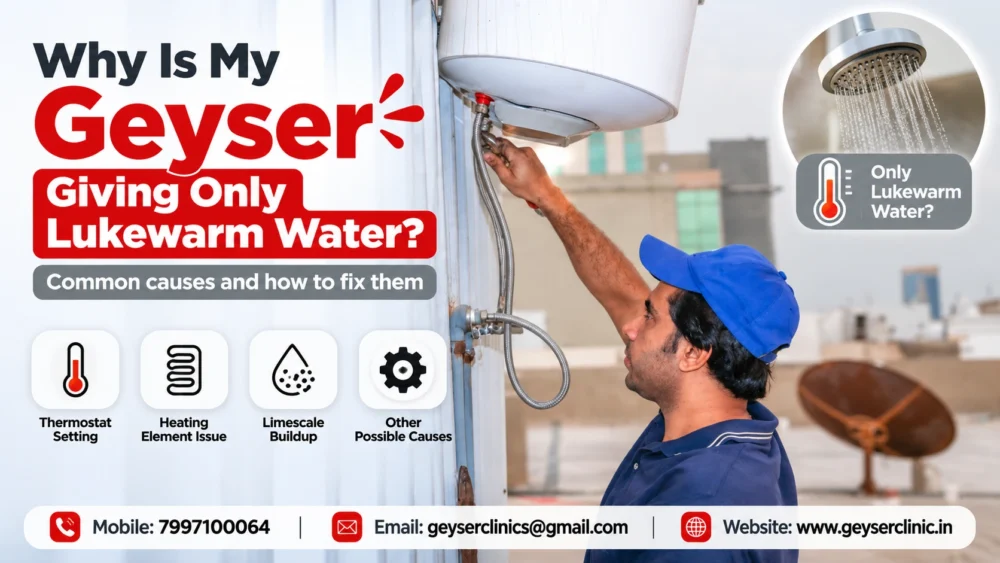
Why Is My Geyser Giving Only Lukewarm Water? Causes, Checks and Solutions
A geyser that produces lukewarm water instead of properly hot water is one of the most common signs that something may be affecting the heating process.
The problem is not always a completely failed heating element. Thermostat problems, scale buildup, high hot-water demand, control faults, temperature settings, or other component issues can all produce similar symptoms. Manufacturer troubleshooting guidance also identifies heating elements, thermostats, sediment, water demand and recovery time as possible reasons for inconsistent or insufficient hot water.
For homeowners searching for a Geyser repair center in Bachupally, the useful first step is to understand when the water becomes lukewarm, whether the problem is new or gradual, and what other symptoms are present.
GEYSER CLINIC can assist customers in Bachupally, Nizampet, Pragathi Nagar, Bowrampet and Miyapur with geyser diagnosis and repair requirements.
Quick Answer: Why Is My Geyser Giving Only Lukewarm Water?
The most likely possibilities are:
- Heating element deterioration or failure
- A thermostat or temperature-control problem
- Scale or sediment buildup
- Excessive hot-water usage before the tank has recovered
- An incorrect temperature setting
- A sensor or electronic control issue on applicable models
- Heat loss through plumbing or a mixing-valve problem
- A geyser that is no longer adequate for the household’s current hot-water demand
The important distinction is that these are possible causes, not confirmed diagnoses. A technician should test the appliance before a particular component is replaced.
First: Is the Geyser Actually Faulty?
Before assuming there is a component failure, consider the timing of the problem.
Lukewarm water after several people use the geyser
A storage geyser has a finite amount of heated water. If hot water is consumed faster than the appliance can recover, the next person may receive cooler water.
Back-to-back showers or several simultaneous hot-water demands can therefore produce temperature drops even when the heater itself is functioning.
Lukewarm water even after adequate recovery time
If the water remains lukewarm despite allowing the geyser its normal heating period, an appliance or plumbing problem becomes more likely.
This is when the heating element, thermostat, scale buildup and control system deserve closer attention.
1. A Heating Element May Be Deteriorating
The heating element is responsible for transferring electrical energy into heat.
An element does not always fail completely. A problem with the heating system can first appear as:
- Longer heating time
- Lukewarm rather than hot water
- Hot water running out sooner than expected
- Inconsistent temperature
- Eventually, no hot water
Electric water-heater manufacturers identify heating-element problems among causes of inadequate hot water.
However, lukewarm water alone is not enough evidence to conclude that the element needs replacement.
A technician should check the element and the rest of the heating circuit before recommending a part.
2. The Thermostat May Not Be Controlling Temperature Correctly
The thermostat regulates the heating cycle by responding to water temperature.
If it is inaccurate or malfunctioning, the geyser may:
- Stop heating too early
- Produce inconsistent temperatures
- Fail to reach the expected temperature
- Cycle incorrectly
- In some situations, allow excessive heating
Thermostats and heating elements can both contribute to inconsistent water temperatures, so the symptoms can overlap.
Important
Do not open the thermostat cover or attempt to adjust internal electrical components yourself. Water-heater manufacturers specifically caution against DIY repair of electrical wiring, heating elements, temperature sensors and safety devices.
3. Scale and Sediment Can Reduce Heating Performance
Minerals in water can accumulate inside a storage geyser over time.
A layer of scale or sediment can interfere with heat transfer, making the appliance work harder and take longer to heat water. Hard-water conditions can accelerate mineral buildup.
Signs that may point toward buildup
- Heating has gradually become slower
- Water is not as hot as it used to be
- Geyser produces rumbling or popping sounds
- Hot water runs out sooner
- The appliance takes longer to recover
Unusual rumbling or popping during heating is commonly associated with mineral or sediment buildup in tank-type water heaters.
A useful related topic
If you notice discoloration as well as poor heating, a related guide such as “Can Regular Geyser Servicing Prevent Major Repairs?” can explain why maintenance and inspection matter.
4. Your Geyser May Be Too Small for Current Usage
A geyser can work correctly and still struggle to provide sufficiently hot water if household demand has increased.
For example, perhaps:
- More people now live in the home.
- More showers are being taken consecutively.
- Hot water is being used simultaneously in multiple bathrooms.
- The geyser’s capacity no longer matches the household’s requirements.
In these situations, the problem may not be a component failure at all.
If hot water is consistently inadequate despite the geyser appearing mechanically sound, capacity and usage patterns should be considered before replacing parts.
5. Temperature Settings May Be Affecting the Result
Some geysers allow users to select or adjust a temperature setting.
If the setting has been changed, the water may simply be heating to a lower target temperature than expected.
Before assuming there is a fault, check the manufacturer’s recommended operating instructions for your particular model.
Avoid setting temperatures excessively high simply to compensate for lukewarm water. Higher water temperatures can increase the risk of scalding.
6. A Mixing Valve or Plumbing Issue Can Make Hot Water Feel Lukewarm
Sometimes the geyser is heating correctly, but the problem occurs after the water leaves the appliance.
For example, a thermostatic or shower mixing valve can affect the temperature reaching the tap. Pressure changes elsewhere in the plumbing can also create temperature fluctuations.
A useful clue is whether:
- Every hot-water outlet produces lukewarm water, or
- Only one shower/tap has the problem.
If only one outlet is affected while other hot-water outlets are normal, the problem may be at that fixture rather than inside the geyser.
Symptoms Can Help Narrow the Diagnosis
What you notice | Possible explanation |
Lukewarm after heavy usage | Insufficient recovery time or high demand |
Lukewarm all the time | Heating/control problem possible |
Gradually slower heating | Scale, element deterioration or other wear |
Rumbling/popping | Possible sediment or mineral buildup |
One tap is lukewarm | Possible mixing-valve/plumbing issue |
Entire house has reduced hot water | Geyser-side problem more likely |
Temperature fluctuates | Thermostat, scale, demand or plumbing issue |
Water is discolored too | Corrosion, mineral deposits or water-quality issue |
This table is a diagnostic guide, not a replacement for testing.
What Can You Safely Check at Home?
You can collect useful information without opening the geyser.
Check the heating pattern
Ask:
- Does the water become lukewarm immediately?
- Does it become hot initially and then turn lukewarm?
- Does the problem occur only after multiple showers?
- Has heating become slower than before?
Check the indicator or display
If your geyser has a power indicator, temperature display or error code, note what it shows during the heating cycle.
A power light alone does not prove that the heating element is operating correctly.
Check the external switch
Confirm that the geyser’s external power switch is in its normal operating position.
Check for visible warning signs
Look for:
- Water leakage
- Corrosion
- Burn marks
- Damaged external wiring
- Unusual noises
- Error messages
Do not remove electrical covers, test live terminals, bypass safety devices or attempt to replace the heating element yourself.
When Does Lukewarm Water Need Professional Diagnosis?
Professional inspection is particularly appropriate when:
- The problem occurs every time, even after adequate recovery.
- Heating has become significantly slower.
- The MCB repeatedly trips.
- There is water leakage.
- You notice a burning smell.
- The geyser makes persistent unusual noises.
- The temperature fluctuates unexpectedly.
- An error code appears.
- The geyser is old and performance has deteriorated.
- You cannot determine whether the problem is electrical, mechanical or plumbing-related.
A proper diagnosis may involve checking the heating element, thermostat, safety controls, electrical circuit, scale buildup and relevant plumbing components.
Can Regular Geyser Servicing Prevent Major Repairs?
Regular maintenance cannot guarantee that a geyser will never fail. Components still wear out.
However, inspection can identify issues such as scale buildup, corrosion, leaks and deteriorating components before they develop into more serious problems. Manufacturer guidance recommends maintenance based on factors such as water quality, usage and system condition.
For households experiencing recurring slow heating or temperature fluctuations, maintenance may be particularly useful.
A sensible service inspection can consider:
- Heating performance
- Heating element condition
- Thermostat/control operation
- Scale or sediment
- Electrical connections
- Leakage
- Corrosion
- Safety components
What Causes a Geyser to Burst?
A geyser does not normally “burst” simply because the water becomes lukewarm.
Serious tank failure can instead involve internal corrosion, excessive pressure, damaged components, deterioration or other installation and operating conditions.
Sediment can contribute to overheating and tank stress over time, while corrosion can weaken the tank.
A leaking tank, significant corrosion, unusual pressure-related symptoms or a malfunctioning safety system should not be ignored.
Never block or disable a temperature-and-pressure relief device. Manufacturer documentation specifically warns against plugging the relief-valve outlet.
How Do I Know When My Geyser Needs to Be Replaced?
Lukewarm water alone does not automatically mean the geyser needs replacement.
Consider the condition of the entire appliance:
Repair may be considered when:
- The tank remains structurally sound.
- The problem is limited to a replaceable component.
- Suitable parts are available.
- The overall appliance condition is good.
Replacement may need consideration when:
- The tank itself is leaking or severely corroded.
- Multiple major components are failing.
- Repairs are becoming recurrent.
- Suitable parts are difficult to obtain.
- The appliance no longer meets household demand.
- The overall repair economics no longer make sense.
The age of the appliance matters, but age alone should not determine the decision. A professional inspection can distinguish a repairable component problem from a deteriorating tank.
Geyser Repair in Bachupally and Nearby Areas
If your geyser is producing only lukewarm water and the problem continues despite normal recovery time, GEYSER CLINIC can assist customers searching for a Geyser repair center in Bachupally.
Service enquiries can also come from nearby areas:
- Nizampet
- Pragathi Nagar
- Bowrampet
- Miyapur
When contacting GEYSER CLINIC, provide the geyser brand, capacity, approximate age, whether the water is completely cold or lukewarm, how long heating takes, whether the problem affects all outlets, and whether there are unusual noises, leaks or error codes.
These details can make the diagnostic process more focused.
GEYSER CLINIC
Mobile: 79971 00064
Email: geyserclinics@gmail.com
A Fresh CTA: Find Out Why the Water Is Lukewarm
Before buying a replacement geyser, find out whether the problem is actually inside the geyser.
If lukewarm water has become a recurring problem in Bachupally, Nizampet, Pragathi Nagar, Bowrampet or Miyapur, GEYSER CLINIC can help assess the likely cause—from heating performance and thermostat operation to scale-related problems and other service requirements.
Call 79971 00064 or email geyserclinics@gmail.com with your geyser’s brand, capacity and symptoms so the problem can be approached from the evidence rather than guesswork.
Frequently Asked Questions
Why is my geyser giving only lukewarm water?
Possible causes include heating-element problems, thermostat faults, scale buildup, insufficient recovery time, high hot-water demand, temperature settings or plumbing/mixing-valve issues.
Why does my geyser become lukewarm after one shower?
The tank may not have recovered enough hot water after the first shower. If the problem happens consistently even after adequate recovery time, the appliance should be inspected.
Can a bad thermostat cause lukewarm water?
Yes. A thermostat or temperature-control problem can cause the heating cycle to stop incorrectly or produce inconsistent temperatures. However, testing is needed to confirm the fault.
Can scale buildup make a geyser heat slowly?
Yes. Mineral deposits can interfere with heat transfer and make the heating system work harder and longer.
Why is my geyser making a rumbling noise?
Rumbling or popping can be associated with mineral or sediment buildup in tank-type water heaters. Other sounds can have different causes, so persistent or unusual noises warrant inspection.
Should I replace my geyser if it gives lukewarm water?
Not automatically. A replaceable component may be responsible. Replacement becomes more relevant when the tank is leaking or severely corroded, major components repeatedly fail, or the appliance no longer makes economic or practical sense to repair.
Can regular servicing prevent geyser failure?
Maintenance cannot prevent every failure, but inspection can identify developing problems such as scale, corrosion, leakage and component wear earlier.
What causes a geyser to burst?
Serious tank failure can involve corrosion, excessive pressure, deterioration or safety-system problems. A leaking or badly corroded tank requires professional assessment rather than DIY repair.
Where can I find a Geyser repair center in Bachupally?
Customers in Bachupally can contact GEYSER CLINIC for geyser diagnosis and repair assistance. Nearby areas include Nizampet, Pragathi Nagar, Bowrampet and Miyapur.
Related Topics for Internal Linking
Use these articles to build a focused topical cluster:
- Can Regular Geyser Servicing Prevent Major Repairs?
Anchor: regular geyser servicing - What Causes a Geyser to Burst?
Anchor: causes of geyser burst - How Do I Know When My Geyser Needs to Be Replaced?
Anchor: when to replace a geyser - Main local service page
Anchor: Geyser repair center in Bachupally - Supporting local pages, where available
Anchors: geyser repair in Nizampet, geyser repair in Pragathi Nagar, geyser repair in Bowrampet, geyser repair in Miyapur
Use contextual anchors rather than inserting the exact-match keyword repeatedly throughout every paragraph.
Conclusion
A geyser giving only lukewarm water does not automatically mean that the heating element has failed or that the entire appliance needs replacement.
Start by checking when the problem occurs, how much hot water is being used, whether heating has become slower, whether all outlets are affected, and whether unusual noises, leaks or error codes are present.
Possible causes include heating-element deterioration, thermostat problems, scale buildup, insufficient recovery, high demand and plumbing or mixing-valve issues.
If the problem persists, professional diagnosis can establish the actual cause and help determine whether the appropriate solution is maintenance, component repair or complete replacement.
For customers in Bachupally, Nizampet, Pragathi Nagar, Bowrampet and Miyapur, GEYSER CLINIC can assist with geyser diagnosis and repair requirements.